the nameless city
ruinThe nameless city is a vast prehistoric ruin buried beneath the sands of the Arabian desert, once a mighty seacoast metropolis that ruled the world before Africa rose from the waves, and now a place so ancient and dreadful that no legend names it and all tribes shun it.
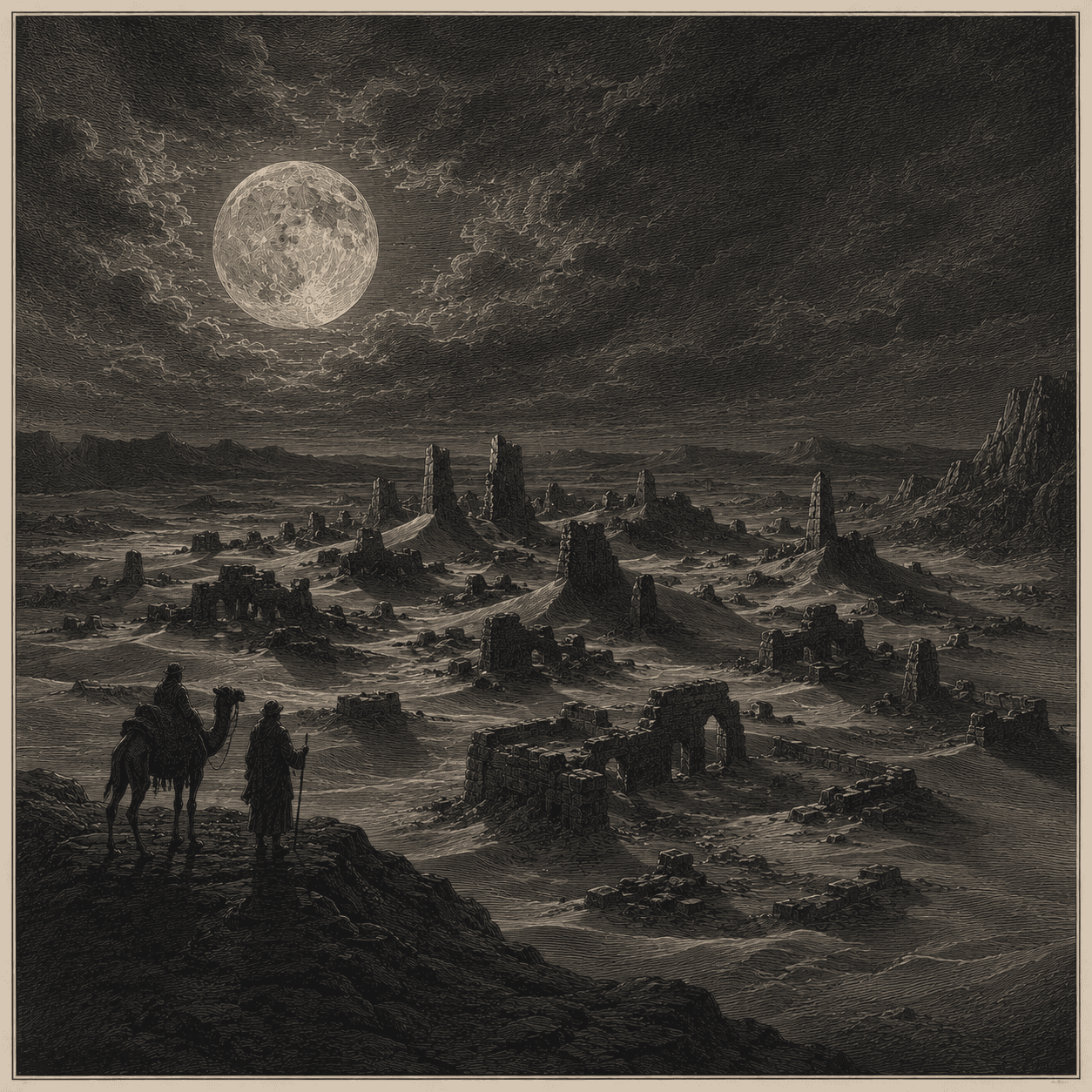
The nameless city protrudes uncannily above the desert sands as parts of a corpse might protrude from an ill-made grave, its age-worn stones called a hoary survivor of the deluge and great-grandmother of the eldest pyramid. It lies remote in the desert of Araby, crumbling and inarticulate, its low walls nearly hidden by sands of uncounted ages; there is no legend so old as to give it a name or recall that it was ever alive, and all the tribes shun it without wholly knowing why. Abdul Alhazred the mad poet dreamed of this place the night before he sang his unexplainable couplet, and the narrator alone of living men has seen it.
Its ruins consist of shapeless foundations of houses and palaces bearing no carving or inscription, while a low cliff nearby holds the hewn facades of several small, squat rock houses or temples. One cavern proved to be a temple with primitive altars, pillars, and niches, all curiously low, its stones shaped into symbols; a presence seemed to stalk among the spectral stones of the city, and the moon itself seemed to quiver as though mirrored in unquiet waters.
According to the pictured epic found within, the city ruled the world before Africa rose out of the waves, and struggled as the sea shrank away and the desert crept into the fertile valley that held it. Thousands of its people, represented in allegory by grotesque reptiles, were driven to chisel their way down through the rocks to another world foretold by their prophets, and the race dwelt in the city and its valley for ten million years. Its civilization, which included a written alphabet, had seemingly risen to a higher order than the far later civilizations of Egypt and Chaldea, yet its frescoes showed no deaths or funerals save those tied to wars, violence, and plagues, and depicted the city's own desertion and growing ruin under moonlight. The Arabs fear the nameless city, and an ancientness so vast that measurement is feeble seems to leer down from its primal stones and rock-hewn temples.
The Great Temple
The largest of the rock-hewn shrines first appeared as a black orifice a long distance to the south, from which an icy wind poured; it loomed larger than the rest as one approached, and its doorway was far less clogged with caked sand. It proved larger than either of the temples visited before, and was presumably a natural cavern, since it bore winds from some region beyond; its stones and altars were as low as those in the other temples, but its walls and roof carried traces of ancient pictorial art, and two of its altars bore curvilinear carvings. Within it a small, plainly artificial door had been chiselled in the solid rock, opening onto a narrow passage where a steep, low-roofed flight of tiny steps descended into darkness.
The Abyss
Beyond the descending corridor the temple opened on a phosphorescent gulf of the inner earth. Sudden gusts of air rose around the mouth of the abyss at each sunset and sunrise, and one caught in them feared being swept bodily through the open gate into the phosphorescent abyss beyond; outlined against its luminous aether appeared a horde of devil-like creatures that could not be seen against the dusk of the corridor.
Connected locations
Characters
Creatures
Sources
Every fact above traces back to the text.
“I saw it protruding uncannily above the sands as parts of a corpse might protrude from an ill-made grave.”
The Nameless City (1921)
“the tale of a mighty seacoast metropolis that ruled the world before Africa rose out of the waves, and of its struggles as the sea shrank away, and the desert crept into the fertile valley that held it.”
The Nameless City (1921)
“the leave-taking of the race that had dwelt in the nameless city and the valley around for ten million years”
The Nameless City (1921)
“This temple, as I had fancied from the outside, was larger than either of those I had visited before; and was presumably a natural cavern since it bore winds from some region beyond.”
The Nameless City (1921)
“I dropped prone again and clutched vainly at the floor for fear of being swept bodily through the open gate into the phosphorescent abyss.”
The Nameless City (1921)